

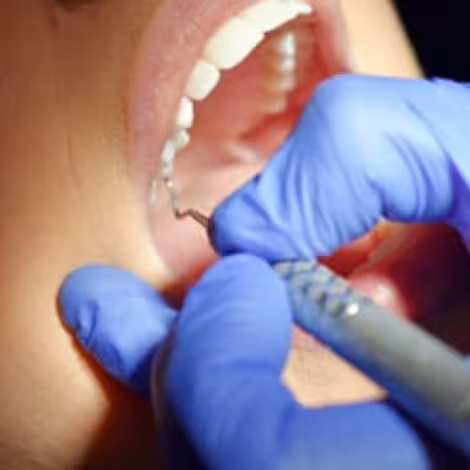
Advanced Instrumentation for the General Practice Dental Hygienist
COURSE NUMBER: 569
Vickie Parrish Foster, RDH, BS, MEd; Joy Void-Holmes, RDH, BSDH, DHSc
Credit Hours:
2 Hour(s)
This course is written for the dental hygienist practicing in a general dental setting. It begins with the standard periodontal instruments most hygienists already use, then broadens that foundation with advanced instrument designs that are...
(Use this feature to create assignments for your students and staff.)
Overview
This course is written for the dental hygienist practicing in a general dental setting. It begins with the standard periodontal instruments most hygienists already use, then broadens that foundation with advanced instrument designs that are often missing from a typical hygiene set-up, along with the clinical techniques required to use them effectively. A standard kit serves many patients well; however, for those with deeper pockets, complex root morphology, residual calculus, or implants, it often falls short. The advanced instruments and techniques reviewed in this course are designed to close that gap during initial therapy and periodontal maintenance From there, the course looks closely at instrument design, the handle, shank, and working end, and how these features translate into clinical use. It covers modified Gracey and specialty curettes and scalers from multiple manufacturers, along with options for maintaining a sharp cutting edge, from stainless steel instruments that require sharpening to sharpen-free designs. It considers glove fit, dexterity, pinch force, and hand fatigue as factors in both instrumentation and the operator’s musculoskeletal health, and it reviews advanced fulcrum strategies and patient–operator positioning that open access to demanding sites, particularly deep pockets and anatomically complex roots. Biofilm management and implant-safe instrumentation round out the scope. During the COVID-19 pandemic, professional guidance emphasized minimizing aerosol-generating procedures, which increased reliance on hand instrumentation.1,2 Current evidence and clinical reviews indicate that hand and ultrasonic instrumentation are both effective for biofilm and calculus removal and can produce similar clinical outcomes when used skillfully; a blended approach is again the norm when aerosols can be managed with high-volume evacuation and appropriate PPE. Some analyses report differences by initial pocket depth and follow-up interval, which supports thorough technique and instrument selection rather than reliance on a single modality. Manual instrumentation remains essential for residual deposits, tight tissues, deep or complex anatomy, limited power access, and clinician preference. Neither hand nor power fully replaces the other. The purpose of this course is to equip hygienists to choose and use advanced manual instruments effectively, manage biofilm thoroughly, protect implant surfaces during maintenance, and apply ergonomic principles - including glove fit, fulcrums, and positioning - so that care is both thorough and sustainable for the clinician's hands
Intended Audience:
Dental Hygienists, Dental Students, Dental Hygiene Students
Date Course Online:
May 1, 2019
Last Revision Date:
Oct 6, 2026
Course Expiration Date:
Oct 5, 2029
Cost:
Free
Method:
Self-instructional
AGD Subject Code(s):
490
Technical Requirements:
Stable internet connection and the latest version of browser and device software are recommended.
Learning Objectives
Upon completion of this course, the dental professional should be able to:
- Apply knowledge of instrument design (handle, shank flexibility, working end, and edge-retention technology) to select the most appropriate instruments for periodontal debridement and residual deposit removal.
- Match advanced instrument designs (After Five, Mini/Micro Mini, 15/16, 17/18, Extra Rigid, Vision Curvettes, Langer, debridement/O'Hehir, diamond-coated files, periodontal files, Nevi, SN 135/137, and related multi-brand equivalents) to root morphology, pocket depth, and deposit type.
- Utilize alternative fulcrums and patient/clinician positioning to improve access, adaptation, and ergonomics while reducing risk of musculoskeletal strain.
- Select implant-safe instrumentation approaches (plastic, graphite, titanium-coated, or dedicated implant instruments) that protect the implant surface while disrupting biofilm.
- Integrate current evidence on hand and power instrumentation and professional biofilm management into clinical decision-making for initial therapy and supportive periodontal care.
- Compare traditional sharpenable stainless steel with sharpen-free and extended-edge technologies and describe implications for technique, maintenance, and instrument replacement.
- Explain how glove fit influences dexterity, pinch force, tactile sensitivity, and hand fatigue during instrumentation.
Disclaimers
- P&G is providing these resource materials to dental professionals. We do not own this content nor are we responsible for any material herein.
- Participants must always be aware of the hazards of using limited knowledge in integrating new techniques or procedures into their practice. Only sound evidence-based dentistry should be used in patient therapy.
Note: Registration is required to take test.
Submission Information
Academy of General Dentistry (AGD) Submission For credit transfers to appear in your AGD account in real time, make sure to add your AGD membership number in the field provided on the “Share Your Test Score” page.
CE Broker For all states that use CE Broker for licensure, “proof of completions” are electronically reported the first of every month. If a course was taken in November, the “proof of completion” will be submitted the beginning of December.
Recognition
Approved PACE Program Provider
THE PROCTER & GAMBLE COMPANY
Nationally Approved PACE Program Provider for FAGD/MAGD credit.
Approval does not imply acceptance by any regulatory authority or AGD endorsement.
8/1/2021 to 7/31/2027
Provider ID# 211886
AADH Approved Program Provider
Procter and Gamble is designated as an approved provider by the American Academy of Dental Hygiene, Inc. #AADHPGC (January 1, 2026 - December 31, 2027). Approval does not imply acceptance by a state or provincial Board of Dentistry. Licensee should maintain this document in the event of an audit.
(Use this feature to create assignments for your students and staff.)