


Zirconia (zirconium dioxide) crowns are made of solid monolithic zirconia ceramic material. Although discovered in 1789 by the German chemist Martin Heinrich Klaproth, zirconia has been used as a biomaterial since the late 1960s. Its use as a dental restorative material became popular in the early 2000s with the advent of CAD-CAM technology. In the later part of the decade, they became available as preformed crowns for primary teeth.
Advantages
- They are very aesthetic, with greater durability than composite strip crowns and pre-veneered crowns.
- They are not as technique sensitive as composite strip crowns, as the fabricated crown is cemented with self-adhesive resin cement rather than bonding.
- They take a bit longer to place than stainless steel crowns; about the same as pre-veneered crowns and less than open-faced stainless steel crowns.
Disadvantages
- They are not recommended in patients that are heavy bruxers.
- They are thicker than other crowns
- Greater tooth reduction is required.
- Unlike stainless steel crowns, they cannot be crimped.
- Cost
Technique
(Photos for the zirconium crown technique courtesy of EZ Pedo Crowns.)
Occlusal Depth Cut:
- Prep a trough at the mesial-edge marginal ridge AT LEAST the COMPLETE thickness of the EZ-Prep 001 donut bur. Repeat at the distal marginal ridge.
- Prep and blend the remaining center of the occlusal table that remains between the mesial and distal depth cuts to create a uniform occlusal reduction.
If six year molars have not erupted, go back and prep the distal half of the occlusal table of the second primary molars slightly more up to 2 mm. This adjustment will reduce the chance of the second molars’ occlusion being slightly high, particularly when doing crowns on opposing second molars.
Subgingival Axial Reduction:
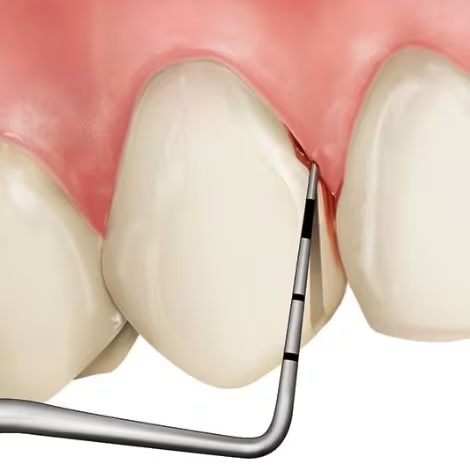
- With the EZ Prep 004 flame bur, remove the chamfer margin at the tissue level. Keep the bur parallel to the long axis of the tooth. To minimize tissue trauma, do not go all the way subgingivally yet. Begin at 0.5 mm subgingivally and go slightly deeper subgingivally with each pass. This technique will minimize trauma to the tissue, thus reducing gingival bleeding.
- Once the chamfer margin is gone, extend the tip of the bur the full 2 mm subgingivally. While hugging the bur axially along the root surface, make 5 circumferential passes. All of the chamfer margin should be gone leaving a smooth transition from the root, past the CEJ, to the coronal tooth.