

Occlusal Considerations for Implant-Supported Prostheses
Course Number: 699
Biophysiological Differences Between Natural Teeth and Dental Implants
The periodontal ligament surrounding the natural teeth protects them from occlusal overload by providing cushioning, shock absorption, proprioception, thermal feedback, and functional adaptability.5,6,8,9 Implants lack the periodontal ligament (PDL) (Figure 1) as they form a rigid connection with the bone.5,6,8,9 Thus, occlusal forces that are well tolerated by natural teeth may not be tolerated by the implants due to the biophysiological difference between them.5,6,8,9 It is therefore critical to understand these differences to achieve or establish an optimal occlusion in implant-supported restorations. They include the following:
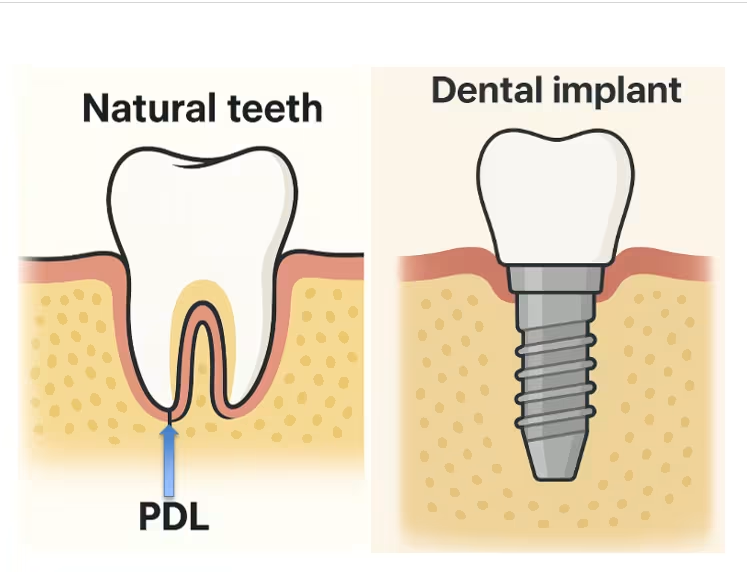
Figure. 1 Natural teeth are surrounded by PDL (Left). Implants are directly attached to the alveolar bone (Right)
Image Source: AI-generated image
Proprioception: Natural teeth have mechanoreceptors that provide proprioception, which conveys sensory input regarding occlusal forces to the central nervous system (CNS) (Figure 2).5,6 This permits optimal regulation of occlusal forces and protects against excessive occlusal loading. The occlusal perception threshold between natural teeth is approximately 20 µm; In contrast, implants demonstrate markedly reduced occlusal perception thresholds: around 48 µm between a tooth and an implant, 64 µm between two implants, and up to 108 µm in implant-supported overdentures.4,5 This reduced sensitivity is associated with the absence of proprioceptive receptors around implants. Implants have osseoperception Q2, a less precise feedback mechanism mediated by surrounding bone and soft tissues.4,5
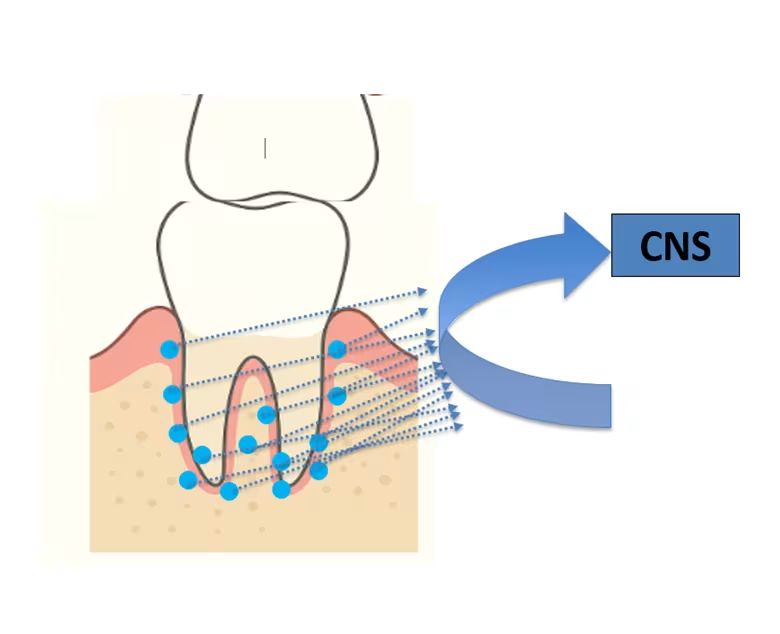
Figure. 2 PDL mechanoreceptors convey sensory input to the CNS
Image Source: AI-generated image
Thermal feedback: Natural teeth demonstrate cold sensitivity when subjected to heavy occlusal forces.14 This adaptive and sensory capacity is absent in implants.
Signs of trauma: When natural teeth are subjected to occlusal trauma, they exhibit early signs such as fremitus, hyperemia, cervical abfraction (Figure 3), PDL widening, and radiographic density changes.12 Implants, on the other hand, do not display any warning signs; by the time the patient complains of pain, the occlusal overload has already caused irreversible tissue damage.5,6
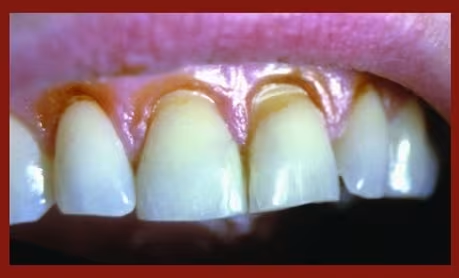
Figure. 3 Cervical abfraction lesions on the maxillary incisors
Load transmission: The PDL acts as a shock absorber, thereby decreasing the stresses transmitted to the bone, particularly in the crestal region.5 Since Implants lack the PDL, there is no dissipation of occlusal forces; instead, high impact forces are directly transmitted to the surrounding bone (Figure 4).
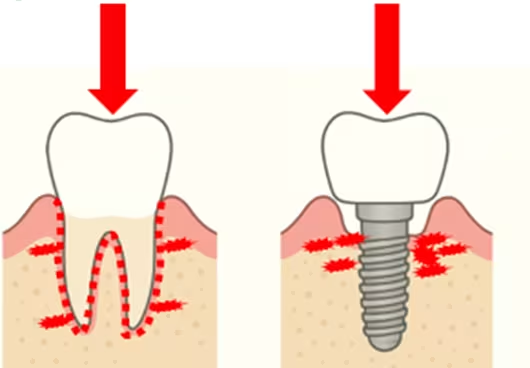
Figure. 4 The PDL helps dissipate occlusal stresses; implants lack a PDL and transmit forces directly to bone.
Image Source: AI-generated image
In addition, the long axis of the natural tooth (crown and root) is generally aligned with the alveolar bone.13 However, implants are often placed more lingually and apically than the natural teeth they replace due to bone resorption following tooth loss.13 Thus, the point of application of force on an implant prosthesis usually lies away from the crestal ridge that anchors the implant, thereby creating unfavorable load transmission.13
Mobility: Natural teeth move 25-100 µm axially and 56-150 µm horizontally under functional load, compared to implants that demonstrate reduced mobility in the range of 3-5 µm vertically and 10-50 µm horizontally.14 This allows natural teeth to adapt to occlusal forces through minor intrusion or rotational movement, whereas implants transmit the entire load directly to the bone-implant interface.14 Furthermore, mobility in natural teeth may be reduced or reversed upon elimination of the traumatic load, while implants lack this adaptive response.15
Type of movement under functional loading: Under loading, the movement of natural teeth is nonlinear and occurs in two phases: an initial phase associated with periodontal ligament displacement, followed by a secondary phase dependent on the elastic deformation of the alveolar bone.14 In contrast, implant movement is linear, lacking the initial phase, and consisting only of a secondary elastic phase.14 Owing to the compressibility and adaptability of the PDL, natural teeth are better able to withstand occlusal forces than implants.9,14
Fulcrum of lateral forces and rotational capacity: Lateral stresses are less detrimental to natural teeth as they are dispersed along the entire root length.9 This is associated with the fulcrum (of lateral forces) being positioned in the apical third of the root.5 Implants, on the other hand, have their fulcrum located at the crestal bone, thereby resulting in a concentration of stresses at the bone-implant interface (Figure 5).5,9
When subjected to lateral loads, natural teeth rotate slightly around the apical third of the root to distribute forces, whereas implants lack this rotational capacity, resulting in stress concentration at the crestal bone and an increased risk of crestal bone loss.9
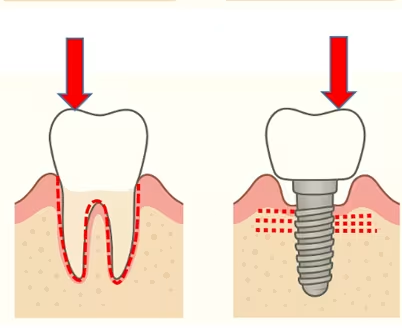
Figure 5. Lateral stresses are dispersed along the entire root length (left); Lateral stresses are concentrated at the bone-implant interface (right).
Image Source: AI-generated image
Size: The diameter of natural teeth is larger than the diameter of implants, and their anatomical form is naturally configured to withstand functional loads.5,6 For example, canine roots are designed to withstand lateral forces, while molar roots are configured to manage vertical (axial) loads.15 In contrast, implant dimensions are dictated primarily by bone availability rather than occlusal load optimization.5,6
Cervical cross-sectional anatomy: The cervical cross-sectional anatomy of natural teeth is adapted to the direction and amount of stress, which helps dissipate the lateral forces. Implants, on the other hand, have a circular design that facilitates their surgical placement but directs load on the crestal bone.5,6
Elastic modulus: Dentin has an elastic modulus similar to that of bone, which helps with optimal stress distribution. However, Titanium (used for implant fabrication) is 5-10 times stiffer than bone and therefore transmits greater stresses to peri-implant bone.5,6
Passive eruption and positional changes: Natural teeth exhibit passive eruption and continuous positional changes throughout life.6 However, implants remain static, which may increase the risk of occlusal imbalance if not regularly monitored.6