

Occlusal Considerations for Implant-Supported Prostheses
Course Number: 699
Occlusal Schemes in Implant Restorations
The key principles of implant occlusion include bilateral stability in centric occlusion, evenly distributed occlusal contacts and force, a broad freedom in centric, mutually protected occlusion whenever feasible and smooth lateral excursions without working or non-working interferences.5,9In addition, the occlusal scheme for implant restorations should be customized and designed in accordance with the opposing dentition or prosthesis, with the primary objective of maintaining occlusal balance and ensuring harmony with existing functional relationships.5,6
1. Recommended occlusal schemes for single or partial implant restorations
Implant restorations opposing natural dentition
When an implant restoration opposes natural dentition, the occlusion should be reconstructed in accordance with the patient’s preexisting occlusal scheme; when the patient has group function, the implant restoration should be restored to conform to group function, whereas in patients with canine-guided occlusion, it should function as part of the established canine guidance. Working and non-working contacts should be avoided on the implant restoration.5,9
When the patient lacks proper occlusion due to several missing teeth, and an implant prosthesis replaces multiple or the majority of posterior teeth in an arch, a mutually protected occlusal scheme (Figure 16) should be planned.8 The anterior teeth can be adjusted to establish proper anterior guidance, thereby preventing posterior interferences during excursions.5,8
When the anterior teeth are being replaced with a fixed implant prosthesis, no contacts (or very light contacts) should occur in the maximum intercuspal position, and the anterior guidance should be kept shallow, since a steeper incisal path may increase the forces transmitted to the implants.38 When replacing a canine with an implant restoration, a group function occlusal scheme is recommended to minimize excessive lateral stresses on the implant during mandibular excursions (Figure 17).
Implant Restoration Opposing Fixed Implant Restorations
When an implant restoration opposes a fixed implant restoration, a mutually protected occlusion is recommended, whenever possible.8 The occlusion should be designed to achieve light, evenly distributed centric contacts.8 Excursive contacts should be avoided; however, if present, they must be carefully controlled to avoid harmful lateral loading.8
Implant Restoration Opposing a Removable Prosthesis
All treatment planning decisions for implant-supported restorations should be based on occlusal and prosthetic strategies to protect the weaker arch.38 Accordingly, the occlusal scheme should be adjusted to accommodate the arch rehabilitated with a complete removable denture/implant overdenture, as it is the weaker arch in the stomatognathic system.38
When an implant restoration opposes a removable/removable implant prosthesis, a bilateral balanced occlusal scheme is recommended.5,32 Bilateral balanced contacts in centric occlusion and during excursive movements are critical for maintaining the stability and retention of removable prostheses.39 The balanced occlusion may be anatomic balanced or lingualized balanced, depending on clinical factors and the prosthetic design.39,40
2. Recommended Occlusal Schemes for Full Arch Implant Restorations
When full-arch fixed prostheses oppose natural dentition or other fixed implant-supported prostheses, a mutually protected occlusal scheme is indicated.4,5 However, when canine guidance cannot be achieved due to factors such as overjet, occlusal plane discrepancies, or wear patterns, group function occlusion may be utilized.4,5 In protrusive movements, the anterior guidance should be distributed over all anterior teeth, including canines, with flat paths and minimal vertical overlap.4 Lateral excursions should be guided either by canines or through group function, using flat paths to limit occlusal stress.4 Posterior cantilevers, when present, should be adjusted to have 100 μm clearance in the maximum intercuspal position and should not contact during working and non-working movements.4,5
When a full-arch fixed implant prosthesis opposes a complete denture or an overdenture, a bilateral balanced occlusion (Figure 18) is recommended to minimize tipping forces and enhance denture stability.5 In cases of severe ridge resorption, a monoplane occlusion may be planned.5
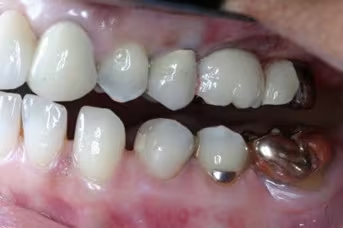
Figure. 16 Implant crowns replacing teeth #14 and #15 restored with a mutually protected occlusal scheme.
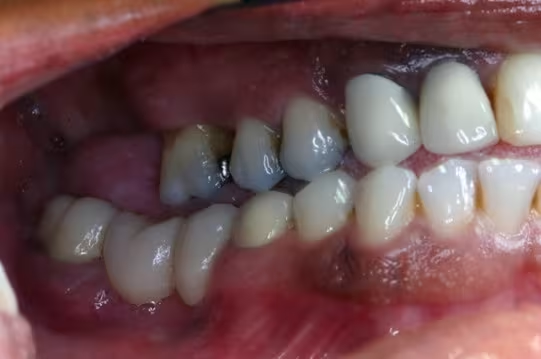
Figure. 17 Group function occlusion established for implant restoration replacing tooth #6
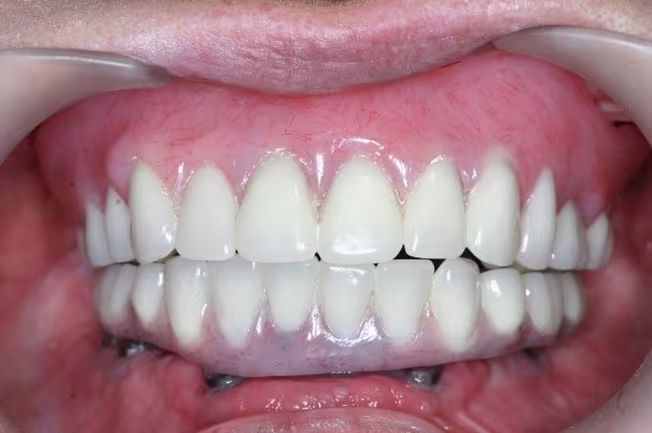
Figure 18 (A)
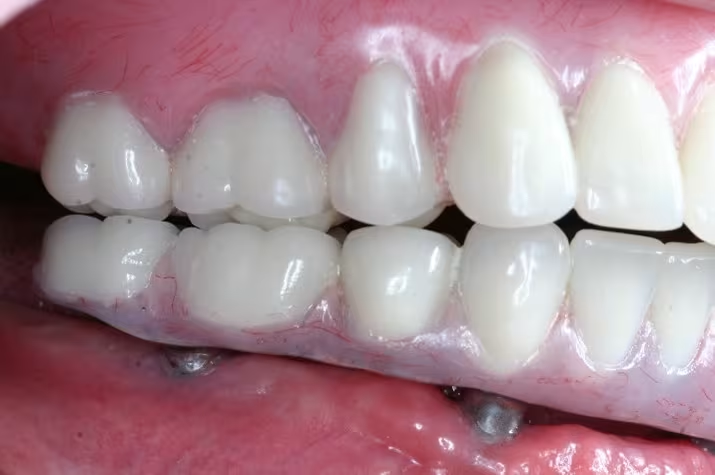
Figure 18 (B)
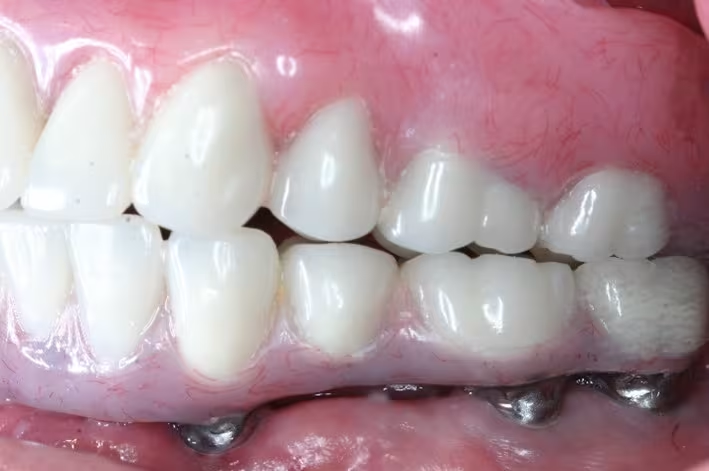
Figure 18 (C)
Figure. 18(A) Mandibular full arch fixed implant prosthesis opposing maxillary implant overdenture restored with a (B,C) bilateral balanced occlusion