

Occlusal Considerations for Implant-Supported Prostheses
Course Number: 699
Risk Factors Associated with Occlusal Overload
Several biomechanical and prosthetic factors can predispose implants to overload and compromise long-term success; they include the following:
Parafunctional Habits
Parafunctional habits (such as bruxism and clenching) are strongly associated with increased prosthetic and biologic complications in implant-supported restorations.4 The magnitude of occlusal forces may vary according to the site and the physical characteristics of these patients, ranging from 100-250 N in the anterior region to 300-800 N in the posterior region.4 In some patients, parafunctional activity may generate forces exceeding 800 N in the molar area.4,22
Patients with parafunctional habits not only exhibit greater occlusal loads but also increased contact frequency and duration.11,23,24 The absence of periodontal ligament-mediated proprioception may further exacerbate parafunctional loading in patients with implant-supported restorations.11 Many studies have linked bruxism with peri-implant marginal bone loss, implant fracture, and eventual implant failure.4,11,25,26
Cantilevers
Cantilevers are commonly linked to the generation of non-axial/lateral forces, subjecting the closest supporting implants to bending movements.4,11,27 They are therefore associated with biomechanical complications such as screw loosening, screw and framework fractures, prosthetic failure, and peri-implant bone loss.28
An increase in the length of the cantilever exponentially increases the stresses on the supporting implant-bone interface (Figure 6).4 A maximum cantilever length of 15 mm in the mandible and 12 mm in the maxilla has been suggested for a full arch implant-supported fixed prosthesis; however, more conservative recommendations advocate limiting distal cantilevers to 7-8 mm to minimize complications.4,9,28
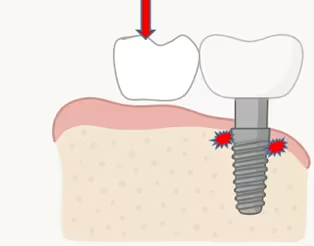
Image Source: AI-generated image
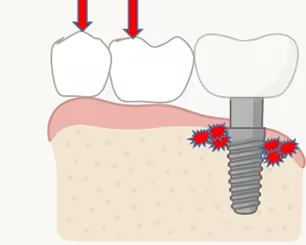
Image Source: AI-generated image
Figure. 6 Increase in the length of the cantilever exponentially increases stresses at the bone-implant interface.
Poor Bone Quality
Bone quality is a critical factor affecting implant stability and success. Poor bone quality (e.g., Type IV) coupled with occlusal overload presents an increased risk of biomechanical complications and implant failure.4,5,29
Temporomandibular Disorders
Existing TMJ dysfunctions/disorders may influence occlusal harmony and should be resolved prior to the fabrication of the definitive restorations.30
Poor Patient Compliance
Long-term success of implant restorations depends on the patient’s adherence to maintenance protocols, including oral hygiene practices and regular professional follow-up.31
Other Contributing Factors
Additional risk factors include an insufficient number of implants,4 incorrect distribution of implants, narrow-diameter and/or short/ultrashort implants, ridge deficiencies, improper implant design (decreased thread height, increased thread width),14 suboptimal passive fit of the prosthetic framework,14 improper prosthetic design, undesirable distribution of occlusal contacts, premature contacts, steep cuspal inclines, wide occlusal tables, improper loading time, and non-axial loading.4,9,32