

Occlusal Considerations for Implant-Supported Prostheses
Course Number: 699
Recommendations for Reducing Occlusal Overload
Misch and Bidez introduced the Implant-protected occlusion in the 1990s to limit occlusal overload.33 This concept emphasizes that, unlike natural teeth, implants are unable to tolerate excessive occlusal forces; therefore, the occlusion must be carefully designed to protect implants from occlusal overload.33 The principal considerations for reducing occlusal overload are described below:5,6,33
1. Implant Orientation and Position
Alveolar bone is better adapted to resist compressive stresses (from axially directed forces) than shear stresses.14 Lateral or oblique forces create bending moments that generate harmful shear stresses at the implant-bone interface.14 The greater the deviation of the load from the implant’s long axis, the greater the shear stresses, which can lead to bone loss and eventual implant failure.14 To achieve favorable loading, implants should be placed perpendicular to the occlusal plane, and angled implants or abutments should be avoided unless dictated by anatomic, prosthetic or esthetic requirements.14 Implant positioning must also be optimized in all three dimensions to minimize offset loading. Planning a cross-bite occlusion for palatally placed posterior implants can help minimize buccal cantilevers and promote axial loading.5
2. Increasing Surface Area for Load Distribution
Excessive stresses should be managed by using wide-diameter implants, increasing implant length, number, and/or splinting multiple implants.9 In the maxilla, additional implants can improve force distribution through tripodism (Figure 7).5 These strategies help increase the surface area for stress distribution, thereby reducing the stresses transferred to the bone.
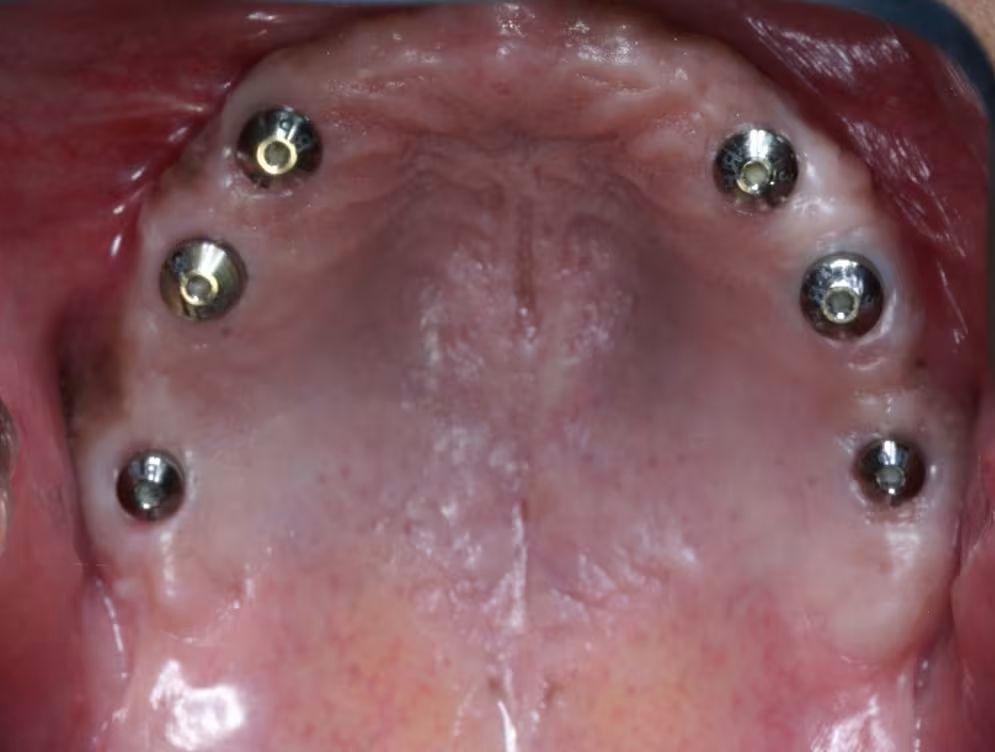
Figure. 7 Additional implants in the maxilla improve load distribution.
3. Loading Protocols
Immediate loading should be avoided in regions with compromised bone quality and/or increased occlusal stresses.5 In such situations, delayed loading or progressive loading protocols are recommended.5 Misch et al. proposed the concept of progressive bone loading for implants placed in areas of compromised bone quality.34 As per this concept, the occlusal forces are gradually increased over six months to promote bone adaptation at the implant interface.34 Appleton et al. reported that progressively loaded implants exhibited enhanced bone density and reduced crestal bone loss, indicating that extended healing times and carefully staged loading protocols are especially advantageous in areas of compromised bone quality.35
4. Occlusal Morphology
Cusp Angulation and Fossa Design: Cusp inclination significantly influences torque generation; with every 10° increase in cusp angle, torque rises by approximately 30%.6,36 To facilitate axial loading, occlusal contacts on implant crowns should occur on flat surfaces oriented perpendicular to the implant body.5,6,15 This may be achieved by widening the central fossa (by 2-3mm) and reducing the cuspal inclines (Figure 8) of the implant crown.5,6,15 In some cases, recontouring of the opposing cusp may be required so that it occludes in the central fossa above the implant body.6,15
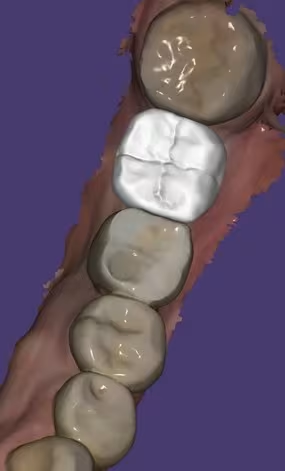
Figure. 8 Implant crown (replacing tooth #18) designed with reduced cuspal inclines.
Crown Height: Excessive crown height (Figure 9) acts as a vertical cantilever, magnifying stresses at the bone-implant interface.5,15 The optimal crown-to-implant ratio should be maintained.15 Any discrepancy should be identified at the treatment planning stage, and surgical augmentation should be considered to avoid creating a vertical cantilever.15 It is also essential to ensure that there is adequate restorative space available for the fabrication of the implant restoration.
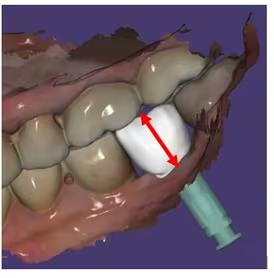
Figure. 9 Excessive crown height
Width of the occlusal table: The width of the occlusal table should be reduced to avoid lateral loading, promote axial force transmission, and limit the chances of restorative material fracture (Figure 10).5,15
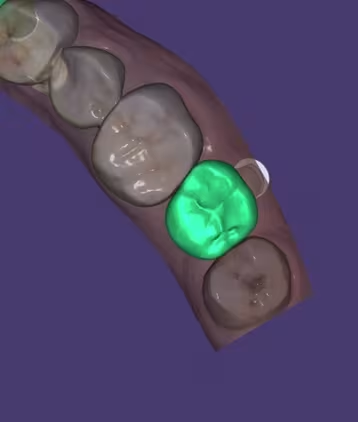
Figure. 10 Implant crown replacing tooth #15 planned with a narrow occlusal table.
Occlusal Contact Position: Primary occlusal contacts should be localized within the central fossa and lie within the implant diameter (Figure 11).5 Secondary contacts should be restricted to 1 mm of the implant periphery.5 Occlusal contacts on the marginal ridge must be eliminated, as they create bending movements.5
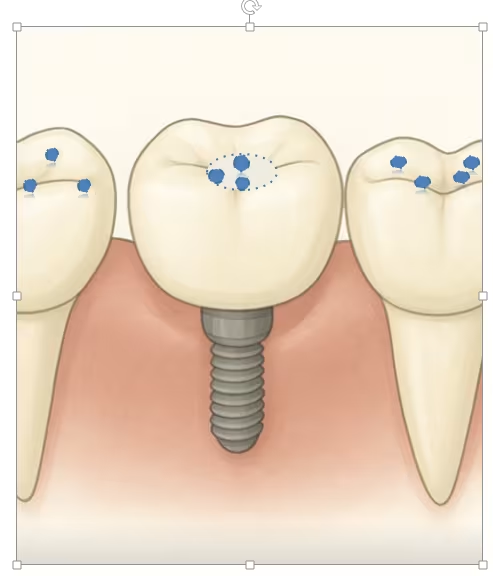
Figure. 11 Primary occlusal contacts (blue) localized within the central fossa of the implant crown.
Image Source: AI-generated image
Crown Contours: Due to ridge resorption, implants are generally positioned at the center of the resorbed ridge, usually beneath the central fossa or the lingual cusp of the missing natural tooth.5,6,15 Additionally, the overall size of the implant body is typically smaller than that of a natural tooth root/roots.5,6,15 Reproducing the full contour of the original tooth may result in a buccal cantilever, creating an offset load that generates compressive, tensile, and shear stresses at the crestal bone around the implant. It is critical to carefully establish the contours and the occlusal contact positions of the implant restoration to minimize these unfavorable stresses.5,6
Curves of Spee and Wilson: It is important to design the occlusal form of the implant restorations in harmony with the existing curves of Spee and Wilson in the natural dentition. These curves play a key role in facilitating protrusive and lateral excursions while minimizing posterior interferences.37 It is therefore critical to replicate these curves in the occlusal design of the implant prostheses. The occlusal design must not only consider the static intercuspation but also dynamic mandibular function, to ensure smooth mandibular movements without interferences.37
5. Cantilever Management
Cantilevers act as force magnifiers and should be eliminated from the prosthetic design whenever possible.4-6 When their use is inevitable, their length and width must be kept to a minimum, and additional supporting implants should be planned to offset the increased functional load.4-6 The stresses associated with the cantilevers may be managed through strategies such as increasing the number of implants, optimizing their anteroposterior spread, and splinting them.4-6 Additionally, use of protective occlusal schemes, including light centric contacts, elimination of contacts in excursions, and avoidance of heavy functional loading on cantilevers, helps with proper stress distribution.4
6. Restorative Material Selection and Management of Parafunctional Habits
Parafunctional habits such as bruxism and clenching exacerbate occlusal forces, resulting in both biological and mechanical complications.5,6 High-strength restorative materials, protective occlusal splints, and occlusal designs that minimize lateral contacts are indicated for patients with parafunctional habits.4-6
7. Establishing Proper Occlusal Contacts
The difference in vertical movement between natural teeth and implants may result in premature occlusal contacts on implant restorations.5,6 Such prematurities must be carefully eliminated, as they concentrate excessive forces on implants (and the crestal bone) and increase the risk of both biological and prosthetic complications.5,6 In cases involving both natural teeth and implant-supported restorations, the occlusion must be adjusted to ensure a graded distribution of forces under different functional loads. Articulating paper (thickness less than 25 μm ) and/or Shimstock may be used for the same.5,6,15 Under light tapping forces, the implant prosthesis should make only slight contact, while the adjacent natural teeth should display more pronounced initial contacts (Figure 12).5,6,15 After occlusal equilibration under light force is achieved, heavier occlusal forces are applied, during which the implant crown and adjacent teeth should exhibit contacts of similar intensity (Figure 13), thereby permitting uniform load distribution.5,6,15
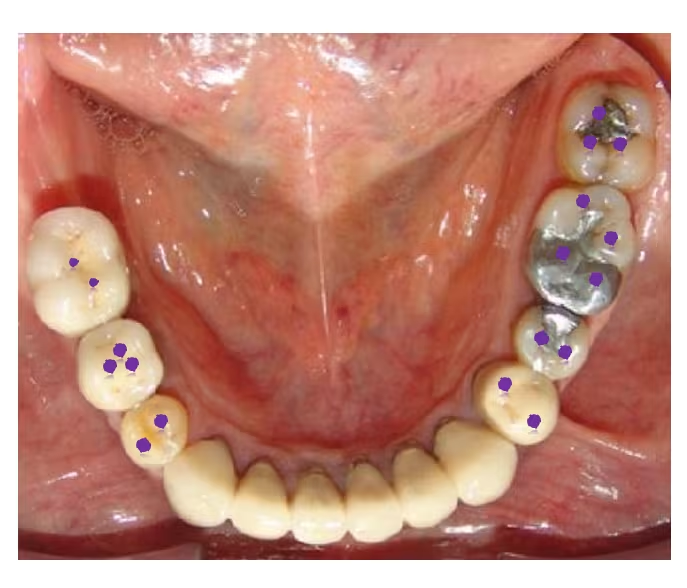
Figure. 12 Under light tapping forces, the implant crown replacing tooth # 30 makes light contact, while the adjacent natural teeth display more pronounced initial contacts.
Image courtesy: Hatami M; CC-BY-3.0
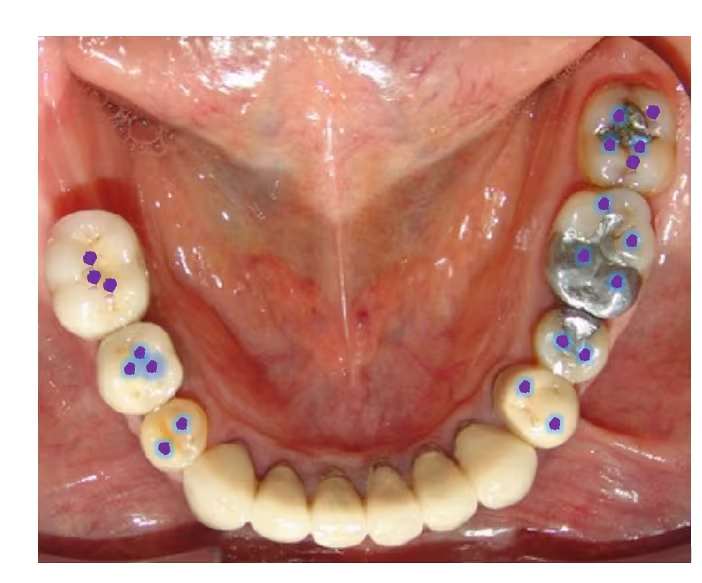
Figure. 13 Under heavier biting forces, the implant crown and adjacent teeth exhibit contacts of similar intensity
Image courtesy: Hatami M; CC-BY-3.
Shimstock testing confirms true occlusal stability. The resistance felt on Shim stock withdrawal in maximum intercuspal position (MIP) confirms true contact (Figure 14), whereas no resistance indicates open contact. When implants oppose natural teeth, the shimstock should exhibit light resistance under light tapping forces and firm retention during clenching; When an implant opposes other implant restoration, the shimstock should exhibit very light resistance under light tapping forces, with holding resistance during clenching at a slightly reduced level compared to natural dentition (Figure 15). Light resistance is better than no resistance, as no resistance indicates a lack of occlusal contact, which may lead to occlusal instability. However, in complete-arch implant-supported prostheses involving one or both arches, no distinction between light and heavy force contacts is required.
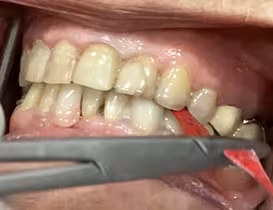
Figure. 14 The resistance felt on Shimstock withdrawal in MIP confirms true contact.
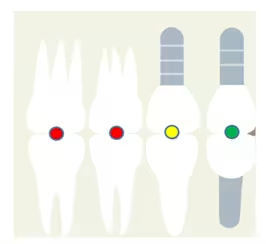
Figure. 15 Under light tapping forces, the Shimstock should hold with resistance between the molar teeth (red dots), pull through with light resistance between the upper second premolar implant crown and the lower second premolar tooth (yellow dot), and pull through easily between the opposing implant crowns (green dot).
Image Source: AI-generated image